I Ching: Can It Predict the Future? Why It Lasted Millennia
Nobody googles ancient divination on a good week; it starts when a job hunt stalls or love implodes. Soon you're on a free online I Ching (Book of Changes) reader, asking if your year is cursed. German mathematician Leibniz got an ancient hexagram chart, marked broken yin lines 0 and solid yang lines 1, counting bottom to top from the Kun hexagram (The Receptive), all-yin 000000, to the Qian hexagram (The Creative), all-yang 111111, mapping 64 hexagrams to 6-bit binary 0 to 63 without a gap. If a book already had the building blocks of computer code lined up 3,000 years ago, figuring out on the side whether your luck turns around next month sounds like using a supercomputer to read your horoscope.
Why Do the I Ching's Yin and Yang Symbols Match Computer Binary Code?
When the French Jesuit missionary Joachim Bouvet sent Fu Xi's Diagram of the 64 Hexagrams to Gottfried Wilhelm Leibniz, it confirmed the binary system Leibniz had already invented independently, and he reportedly published his binary paper in 1703. Watching a co-inventor of calculus check his base-two math against an ancient Chinese chart is like a software engineer cracking open an antique family scroll and finding clean 0s and 1s written in ink brush, with zero syntax errors. Plenty of people read the chart backward because the 64 hexagrams stack six broken yin lines or solid yang lines from the ground up like a six-story building, putting the bottom line at the highest place value of 32 and the top line at the lowest value of 1. Then in 1966, Marshall Nirenberg and his colleagues cracked the 64 genetic codons, where four nucleotide bases combine in triplets to make 64; after matching computer code and then matching human DNA, no wonder people suspect the ancients somehow got read-access to Earth's backend source code.
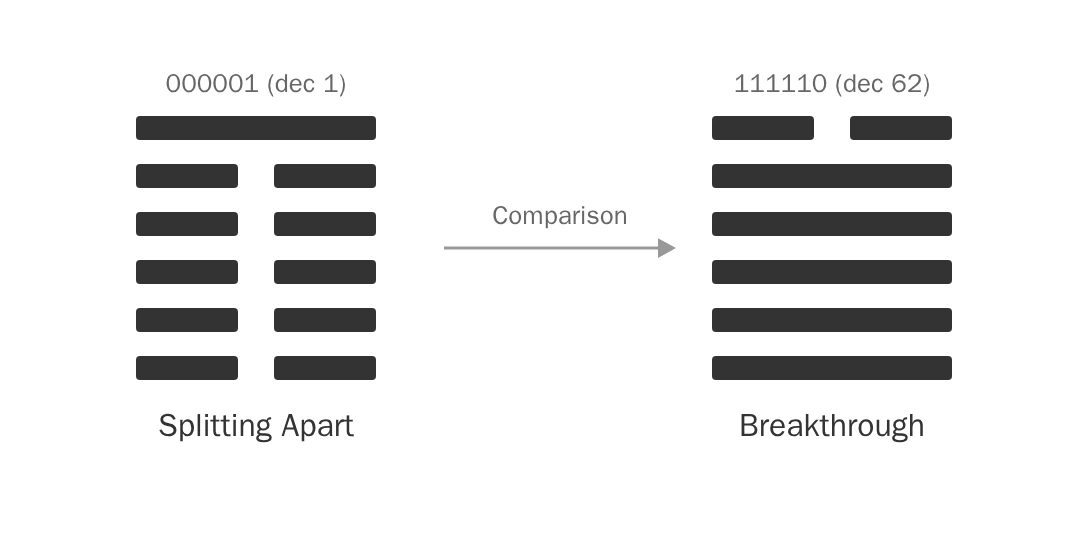
Convert the lines from bottom to top with place values of 32 for the bottom line, 16 for the second, 8 for the third, 4 for the fourth, 2 for the fifth, and 1 for the top line. Five yin lines holding up one yang line in the Mountain-over-Earth Bo hexagram (Splitting Apart) gives 000001, or 1, while five yang lines crowned by one yin line in the Lake-over-Heaven Guai hexagram (Breakthrough) gives 111110, or 62, slotting right between the Kun hexagram at 0 and the Qian hexagram at 63 without a single miss.
What Do Archaeological Digs Reveal the I Ching Was Originally Used For?
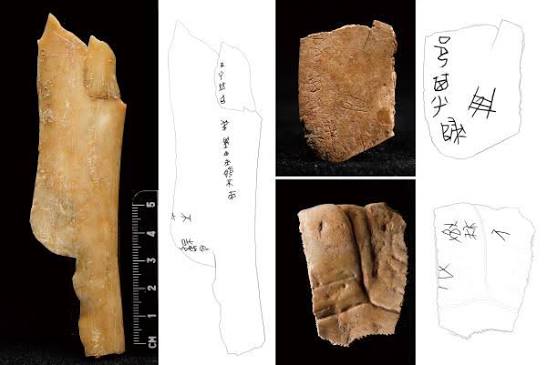
Ancient people didn't lay out those 64 slots to cram for a coding interview; they needed a way to stay alive long before weather forecasts and war-room maps existed. In 2003, archaeologists at the Taosi site in Shanxi excavated the remains of an ancient astronomical observatory where early communities tracked shifting sun shadows to set the farming calendar. In 1976, a storage pit at Zhouyuan in Shaanxi yielded over 17,000 oracle bones bearing micro-carved divination inscriptions one millimeter square on troop marches and capturing prisoners, alongside whetstones carved with numerical hexagrams from Yinxu (the Ruins of Yin). Judging from these excavated artifacts, some argue the I Ching wasn't necessarily just a meal ticket for fortune-tellers, and may also have been a hardcore toolkit for tracking solar terms, smelting bronze, and calculating military strategy. Other commentators note that the Wangjiatai Qin tomb in Jiangling, Hubei yielded Qin bamboo slips alongside a divination board, counting rods, and wooden dice, and argue its hexagram-divination slips belong to the lost Guicang (Return to the Hidden). Adventure stories make tomb raids all about hunting for mystical scrolls of immortality, yet when archaeologists climbed into the tomb, they found bamboo slips paired with counting rods and dice, basically a portable office calculator that never needed a charger tucked into the coffin.
How Do Lianshan, Guicang, and the Zhouyi Differ?
| Classic | Length & Opening Hexagram | Purpose & Survival |
|---|---|---|
| Lianshan (Linked Mountains) | Traditionally about 80,000 characters, reportedly opening with the Gen hexagram (Keeping Still) | Some accounts say it was used for agricultural forecasting; lost after the Qin and Han dynasties |
| Guicang (Return to the Hidden) | Traditionally about 4,300 characters, reportedly opening with the Kun hexagram (The Receptive) | Said to focus on divination; some scholars identify the Wangjiatai Qin divination slips as part of this text |
| The Zhouyi (Changes of Zhou) | Core text estimated at under 5,000 characters, opening with the Qian hexagram (The Creative) and the Kun hexagram | Condenses situational strategies across 64 hexagrams; handed down to the present through the commentary of the Ten Wings |
Why did an 80,000-character Lianshan vanish while a Zhouyi of under 5,000 characters survived? Technical manuals go obsolete the moment a dynasty changes, whereas survival strategy for rock-bottom crises stays hard currency forever, and King Wen of Zhou (Ji Chang) was the prisoner who pieced that strategy together behind bars. While Ji Chang was imprisoned for seven years at Youli by King Zhou of Shang in Zhaoge, the lower Fire trigram Li at 101 met the upper Earth trigram Kun at 000, the sun sinking into the earth to form the Mingyi hexagram (Darkening of the Light), whose judgment reads, "Darkening of the light; in hardship, it pays to persevere." Tradition holds that Confucius studied the Zhouyi in his later years and wrote ten commentaries on its moral reasoning and philosophy of change, known collectively as the Ten Wings, in which the Tuanzhuan (Commentary on the Decision) nails Ji Chang's survival playbook, "Inwardly clear-sighted yet outwardly yielding to endure great calamity; King Wen lived by this." Read through the Tuanzhuan, the move is keeping your mind razor-sharp inside while playing soft and compliant outside, meaning the hexagram hands you a survival plan for holding your nerve in a crisis rather than a pre-written fate. If this book actually handed out spoilers for your release date, Ji Chang could have just scratched a countdown calendar on his cell wall, and Confucius wouldn't have worn through the leather cords binding his bamboo slips rereading it when he could have flipped to the back and copied the answer key.
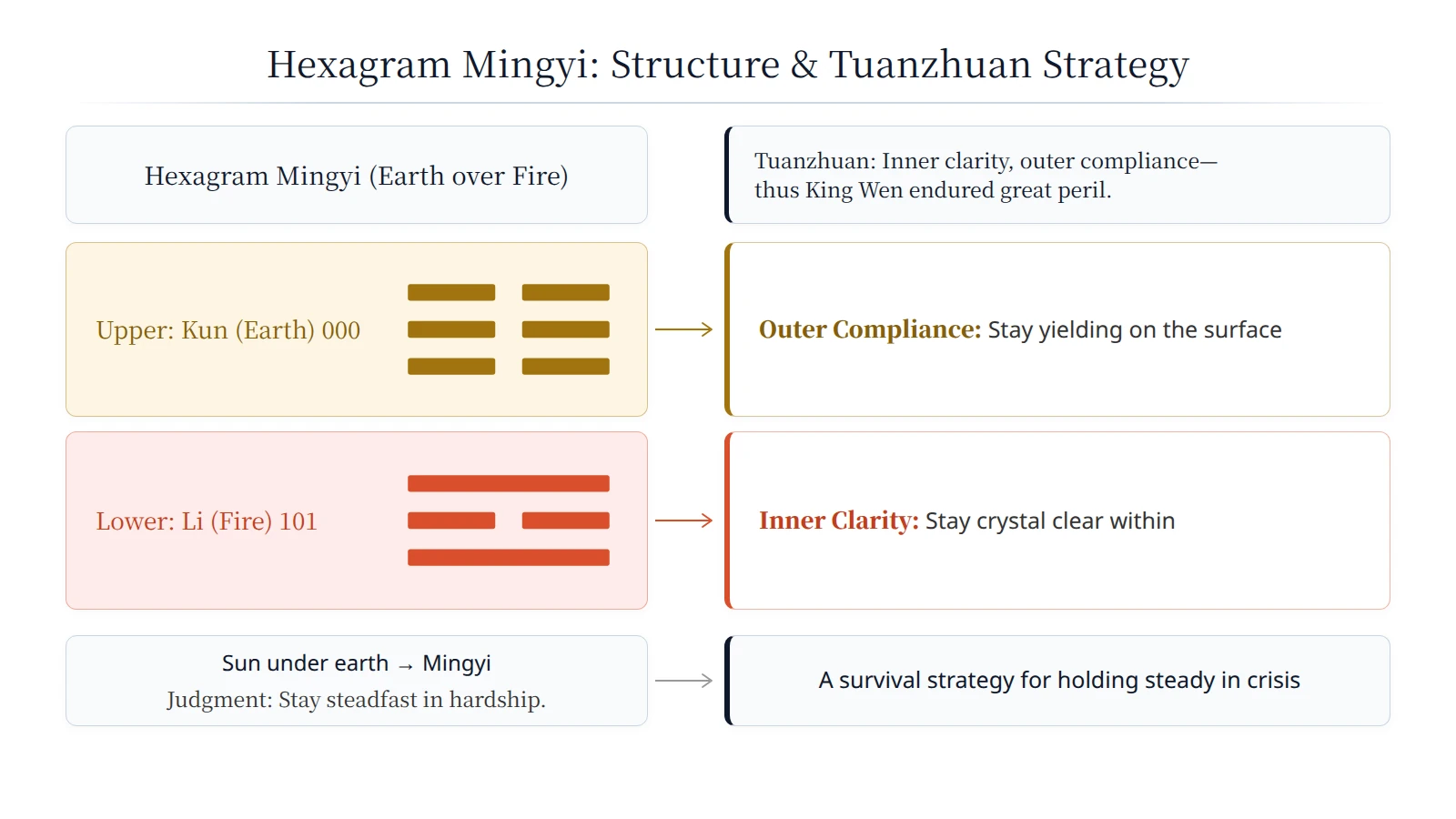
Structure of the Mingyi hexagram (Darkening of the Light) compared with the interpretation in the Tuanzhuan (Commentary on the Decision): the upper trigram Kun (Earth, 000) corresponds to outward compliance, while the lower trigram Li (Fire, 101) corresponds to inner clarity.
If Its Underlying Logic Looks Like Binary Code, Can the I Ching Actually Predict the Future?
Plenty of people still refuse to let that go. If the I Ching maps onto binary code, couldn't you feed in enough starting data and calculate the rest of someone's life the way the French scholar Laplace once imagined? Modern computer science went ahead and yanked the ethernet cord on that idea itself. The scientist Stephen Wolfram ran his "Rule 30" model using plain black and white cells, with rules as simple as yin and yang lines, yet as it evolves downward the right side produces complex patterns with no way to skip ahead for spoilers. Having rules underneath doesn't mean you can drag a progress bar across your life; if you want to know how the second half plays out, the only algorithm is living it one day at a time. Expecting a binary hexagram chart to tell you what month you'll strike it rich is like learning the 26 letters of the alphabet and demanding they crank out a Nature-grade paper by next week. And yet we still find ourselves hoping, and dreading, that one day we really will decode those complex patterns.
So why do so many people cast a hexagram and walk away convinced someone hid a security camera in their living room? After reading the I Ching in translation, the psychologist Carl Jung proposed synchronicity to explain the meaningful resonance between an inner mental state and a random outer hexagram. Its 384 line statements already lay out a full checklist of tailwinds, ambushes, and turning points, so that eerily accurate camera is actually wired inside your own head. When you're losing sleep over quitting your job with nothing lined up and turn to "Hidden dragon, do not act" in the text, your coins haven't tapped into your company's HR system. Deep down, you already ran the numbers on your leverage, and the line simply held up a mirror to your own doubts. That is Astro Bloom's stance as well, since until the universe is fully decoded, nothing can predict with 100% certainty when or whether a specific event will happen, and treating it as a thinking framework for reading situations and self-exploration is the right way to use it.
How Can Everyday People Use the I Ching to Make Better Decisions Today?
- Trade outcome questions for situation checks. Stop asking "What month will I get promoted?" and start asking "What will pushing ahead right now cost me versus holding back to build strength?"
- Run a six-line sandbox with a single coin as a quick binary shortcut instead of the traditional three-coin toss. Flip it six times from bottom to top, log heads as a yang line of 1 and tails as a yin line of 0, and calculate the resulting number from 0 to 63 to look up the hexagram statement.
- Use the line statements as a blind-spot checkup for your decision, so when "Hidden dragon, do not act" comes up, shore up your weak spots first, and when "Perhaps leaping over the depths, no blame" comes up, test the waters in small steps and keep an exit open.
Whether you're actually using the I Ching or just bowing to a mystical oracle comes down to what you want the moment you reach for a coin at midnight, a spoiler or a clear head. From the counting-rod bamboo slips in the Wangjiatai Qin tomb, to "Darkening of the light, persevere in adversity" in Youli prison, to the numbers 0 to 63 on Leibniz's page, this book has always been a calculator for sizing up a situation, never a leaked exam sheet from heaven. Anyone desperate to peek at the answer key can shake their wrist sore, and they're still just slamming coins onto a calculator. Slam them as loud as you want, and it still won't turn into a wishing well.
Frequently Asked Questions
Excavated bamboo slips belong to history, 0s and 1s belong to math, and reading the situation right in front of you belongs to you.
How Do Lianshan and Guicang Differ from the Zhouyi We Read Today?
The three differ in their opening hexagram, length, and purpose. Tradition says Lianshan ran about 80,000 characters, reportedly opened with the Gen hexagram, focused on the agricultural calendar, and was lost after the Qin and Han dynasties; tradition says Guicang ran about 4,300 characters, reportedly opened with the Kun hexagram, and allegedly centered on divination, with some scholars identifying the Wangjiatai divination slips as part of this lost text; and the Zhouyi that survives today became a philosophical classic through the commentary of the Ten Wings.
Are the 64 Hexagrams of the I Ching the Same Thing as Computer Binary Code?
Their base-two place-value structure matches, but their jobs are completely different. Converting Fu Xi's Diagram of the 64 Hexagrams from bottom to top with broken yin lines as 0 and solid yang lines as 1 maps cleanly onto six-bit binary numbers from 0 to 63, a parallel Leibniz reportedly noted in his 1703 paper; still, binary is a universal mathematical encoding system, while the 64 hexagrams were an ancient framework for classifying and navigating real-life situations.
Can the I Ching Actually Predict Someone's Exact Future Outcome?
It can't 100% predict what will happen on a specific day. The I Ching was originally used mostly for divination and working through scenarios, and in Astrobloom's view, today you're better off using it as a thinking framework to spot openings, avoid pitfalls, and catch the blind spots in your situation. Toss a coin as often as you like, and all it turns over for you is the coin. Turning things around next month comes down to what you do once you see your situation clearly.