Zi Wei Dou Shu Needs Birth Time; Use BaZi for Long-Term Luck
You've probably searched “BaZi vs Zi Wei Dou Shu: which one should I start with?” Here's the twist: give both systems the same birth date and time, and you get two different portraits. Read the Qianlong Emperor, who brought the Qing dynasty to its peak, through BaZi (the Four Pillars of Destiny), and he appears as “autumn steel forged by fire.” Read him through Zi Wei Dou Shu (Purple Star Astrology), and he appears as “an emperor star hidden behind a pragmatist's mask.” The reason is in how each system works. BaZi converts the year, month, day and hour of birth into Heavenly Stems and Earthly Branches (the ten stems and twelve branches) and measures the balance of the Five Elements (Wood, Fire, Earth, Metal, Water), while Zi Wei Dou Shu places stars across twelve palaces (the different areas of life) and reads each scene. Have you ever seen the shape of time? Neither system is better than the other. They look from different angles: one reads temperament and the waves of luck (the time axis), and the other reads how each area of life unfolds (the space axis). Want to check this on your own chart? Enter your birth details in the BaZi chart calculator, and try the compatibility reading as well.
Zi Wei Dou Shu vs BaZi: The Key Differences in Axis, Calendar and Origins
The difference between Zi Wei Dou Shu and BaZi comes down to one thing: what each system puts at its center. BaZi measures the strength of the Five Elements carried in time and logically works out your temperament and long-term fortune (a “nature” system). Zi Wei Dou Shu instead maps stars onto twelve scenes of life, such as career and love, and describes specific situations and feelings (an “events” system). Its structure resembles the twelve houses of Western astrology, but it places its stars by its own calculation rules rather than by real planets.
BaZi vs Zi Wei Dou Shu at a Glance
| Feature | BaZi | Zi Wei Dou Shu |
|---|---|---|
| Analytical axis | Time axis (stems, branches and Five Element strength) | Space axis (twelve palaces and star placement) |
| Calendar | Solar calendar (the 24 solar terms and their start dates) | Lunisolar calendar (lunar month and day) |
| Nature of the elements | Abstract symbols: stems, branches and the Five Elements | Calculated virtual stars, including the 14 major stars |
| Strengths | Temperament, talents, waves of luck | How specific areas such as love and career unfold |
| Time resolution | 10-year Luck Pillars and 1-year annual luck | Concrete events by month and by day |
| Unknown birth time | The basics can still be read from three pillars (six characters) | The Life Palace can't be fixed, so the chart is hard to confirm |
Calendars, Historical Background, and Why the Stars Are “Virtual”
The two systems also run on different calendars. BaZi uses the solar calendar of the 24 solar terms, but only 12 of them, the “jie” terms (every other one, starting with the Start of Spring), open a new month, while Zi Wei Dou Shu builds its chart on the lunisolar calendar (the traditional Chinese calendar), which follows the waxing and waning of the moon. Also, stars like the Zi Wei star are not real planets; they are virtual symbolic stars derived by calculation rules. Both systems trace back to the Tang and Song dynasties, yet they differ in origin and structure: BaZi rests on the theory of stems, branches and the Five Elements systematized in Yuanhai Ziping (Sea of Ziping), Di Tian Sui (Dripping Heaven's Marrow) and Qiongtong Baojian (Exhaustive Treasure Mirror), while Zi Wei Dou Shu draws on classics such as Zi Wei Dou Shu Quanshu (The Complete Book of Zi Wei Dou Shu) and reads from the twelve palaces and the placement of the stars.
Time Resolution: Decade-Long Waves or Month-and-Day Moments
BaZi and Zi Wei Dou Shu also divide time differently. BaZi captures life's big turning tides through Luck Pillars (10-year cycles) and annual luck (1-year cycles), but it treats fine shifts from month to month and day to day only as a supplementary reading. Zi Wei Dou Shu starts from the Major Limit (a 10-year cycle) and can layer yearly, monthly and daily charts onto the twelve palaces, so it is designed to make concrete short-term movements easier to track.
How BaZi Works: The Natal Chart, the Ten Gods and the Useful God
BaZi starts by converting the four frames of your birth (year, month, day and hour) into the stem-and-branch system of 60 combinations, which gives an eight-character natal chart (BaZi). Among the year, month, day and hour pillars, the top character of the day pillar is called the Day Master. It is the central axis of the chart and stands for you. Its generating and controlling relationships with the other seven characters measure the balance of Wood, Fire, Earth, Metal and Water. You can study the stem system step by step in the Ten Heavenly Stems course.
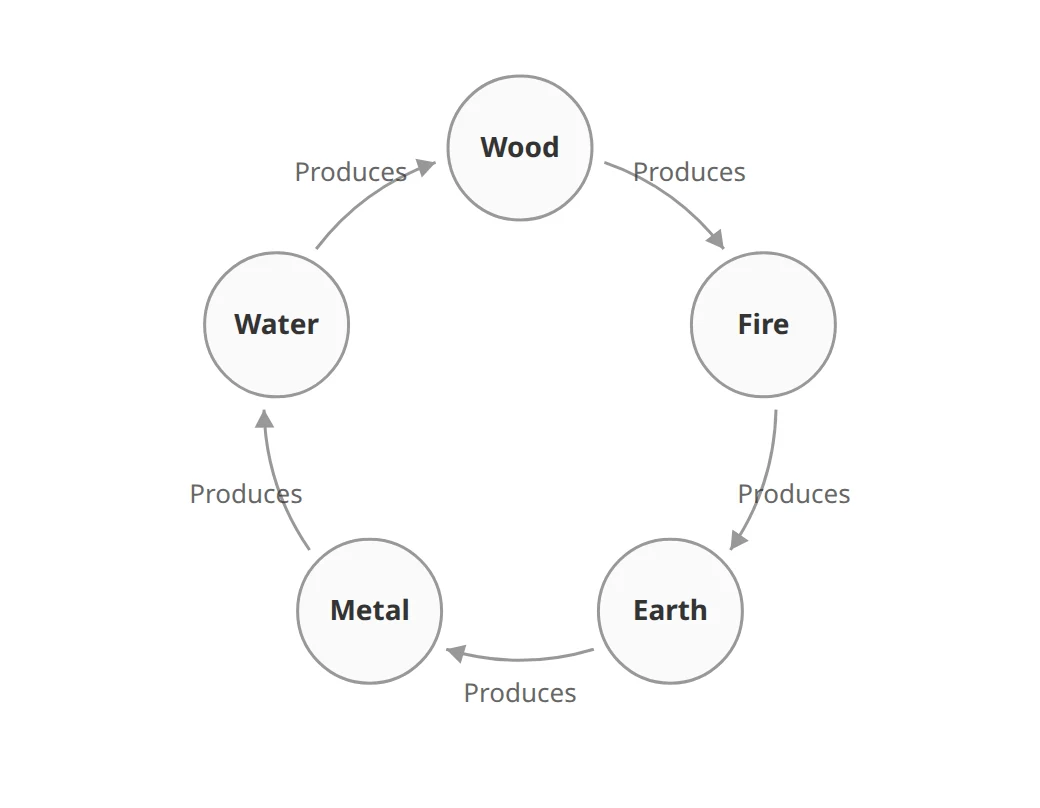
The Five Elements generating cycle (Wood → Fire → Earth → Metal → Water → Wood) is the foundation BaZi uses to measure how strong or weak each element is. When an element runs too high or too low, the element that restores balance becomes the Useful God.
The Ten Gods and the Useful God: A Map of Temperament
The Ten Gods come from how the Day Master relates to the other seven characters in the chart, and there are ten of them: Friend, Rob Wealth, Eating God, Hurting Officer, Indirect Wealth, Direct Wealth, Seven Killings, Direct Officer, Indirect Resource and Direct Resource. For example, if the Day Master is Yang Fire (Bing) and the chart holds a lot of Earth, the Earth that Fire produces becomes Eating God and Hurting Officer, and it shows up as creativity and a talent for self-expression. The last step is to pin down the Useful God that offsets the imbalance, which points to a direction such as tempering excess Fire with Water. For the full details, see The Ten Gods: A Complete Guide to Friend, Rob Wealth and More.
How Zi Wei Dou Shu Works: The Zi Wei Star, the Twelve Palaces and the Four Transformations
Zi Wei Dou Shu works out where your Life Palace sits from your lunar birth month and birth hour. It then lays out 12 rooms (Life, Siblings, Spouse, Children, Wealth, Health, Travel, Friends, Career, Property, Fortune and Parents) across the chart to draw a map of your life. BaZi also has a “Life Palace” as a supplementary star, but in Zi Wei Dou Shu the Life Palace is the lead player and the anchor point for all 12 palaces, so it carries far more weight in a reading.
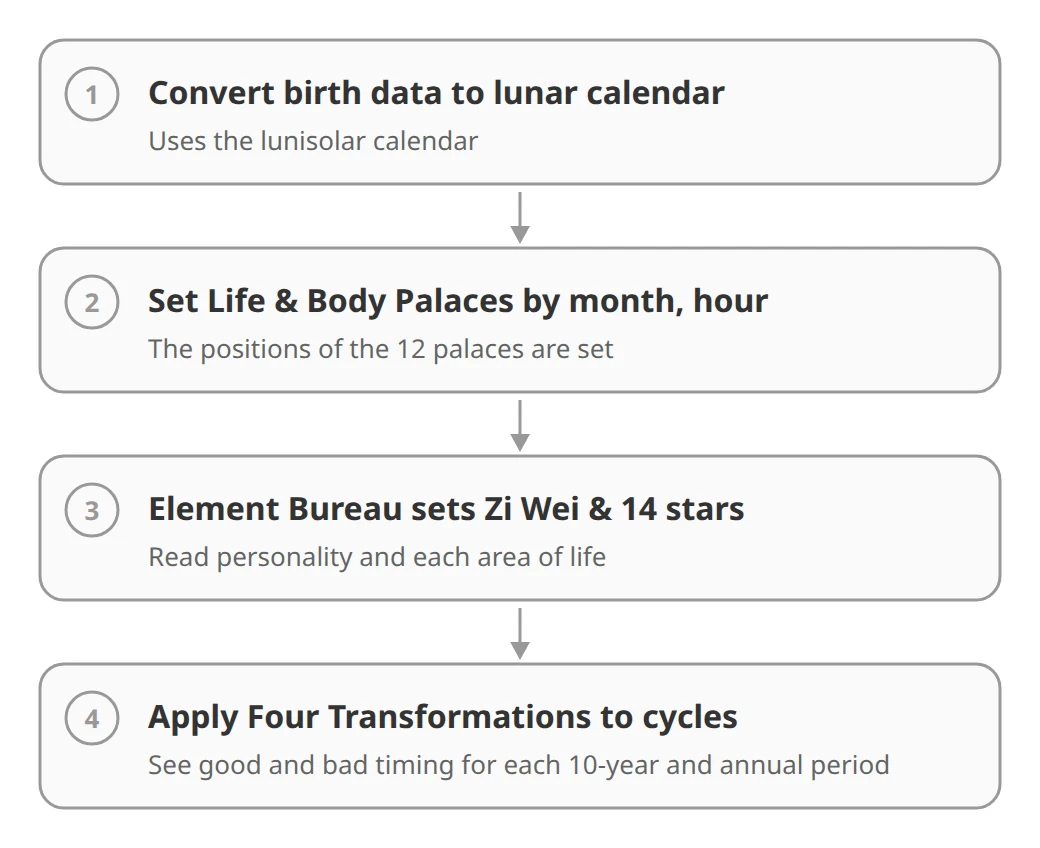
Building a Zi Wei Dou Shu chart takes four steps. You convert the birth date to the lunar calendar and fix the Life Palace. You then use the Five Element Bureau to place the Zi Wei star and the 14 major stars. Finally, you overlay the Four Transformations to read the Major Limits (10-year cycles) and the annual years.
Reading the 14 Major Stars, the Four Transformations and the Major Limits
The lead players in the 12 palaces are the 14 major stars, headed by the Zi Wei star: Zi Wei (Emperor), Tian Ji (Strategist), Tai Yang (Sun), Wu Qu (General), Tian Tong (Harmony), Lian Zhen (Integrity), Tian Fu (Treasury), Tai Yin (Moon), Tan Lang (Desire), Ju Men (Great Gate), Tian Xiang (Minister), Tian Liang (Elder), Qi Sha (Seven Killings) and Po Jun (Army Breaker). The same Zi Wei star means something completely different when it shares a palace with Tian Fu than when it shares one with Po Jun, or with Qi Sha. Readers also track which palace the Four Transformations, Hua Lu (Prosperity), Hua Quan (Power), Hua Ke (Fame) and Hua Ji (Obstruction), fly into during each 10-year Major Limit (the Zi Wei counterpart to BaZi's Luck Pillars) and each annual year, and that is how they spot turning points.
Same Person, Both Systems: A Real Example and the Missing Birth Time Problem
Run the same person through both systems and the difference is stark. To show it, we need someone whose full birth moment is on record. Our example is the Qianlong Emperor, whose birth date and hour are traditionally recorded in the Qing Gaozong Shilu (Veritable Records of Emperor Gaozong of Qing) and other sources (born September 25, 1711, the 13th day of the 8th lunar month in the 50th year of Kangxi, during the Zi hour). His BaZi chart reads Xin Mao year, Ding You month, Geng Wu day and Bing Zi hour. It shows a strong autumn Geng Metal (Yang Metal) that the Fire of Bing, Ding and Wu (Officer and Seven Killings) forges into balance, which points to a structure built for command. His Zi Wei Dou Shu chart (Fire Six Bureau) looks different. The Life Palace (You) holds Tian Xiang, the star of practical work and order, and the Wealth Palace (Si) holds Tian Fu. The Fortune Palace (Hai), which governs the inner life, holds the imperial Zi Wei star together with the general's star Qi Sha, and the Travel Palace (Mao) pairs Lian Zhen and Po Jun. The two charts show the difference clearly. BaZi captures the overall balance of temperament, and Zi Wei Dou Shu draws, palace by palace, “the pragmatic administrator on the outside” and “the conqueror within.”
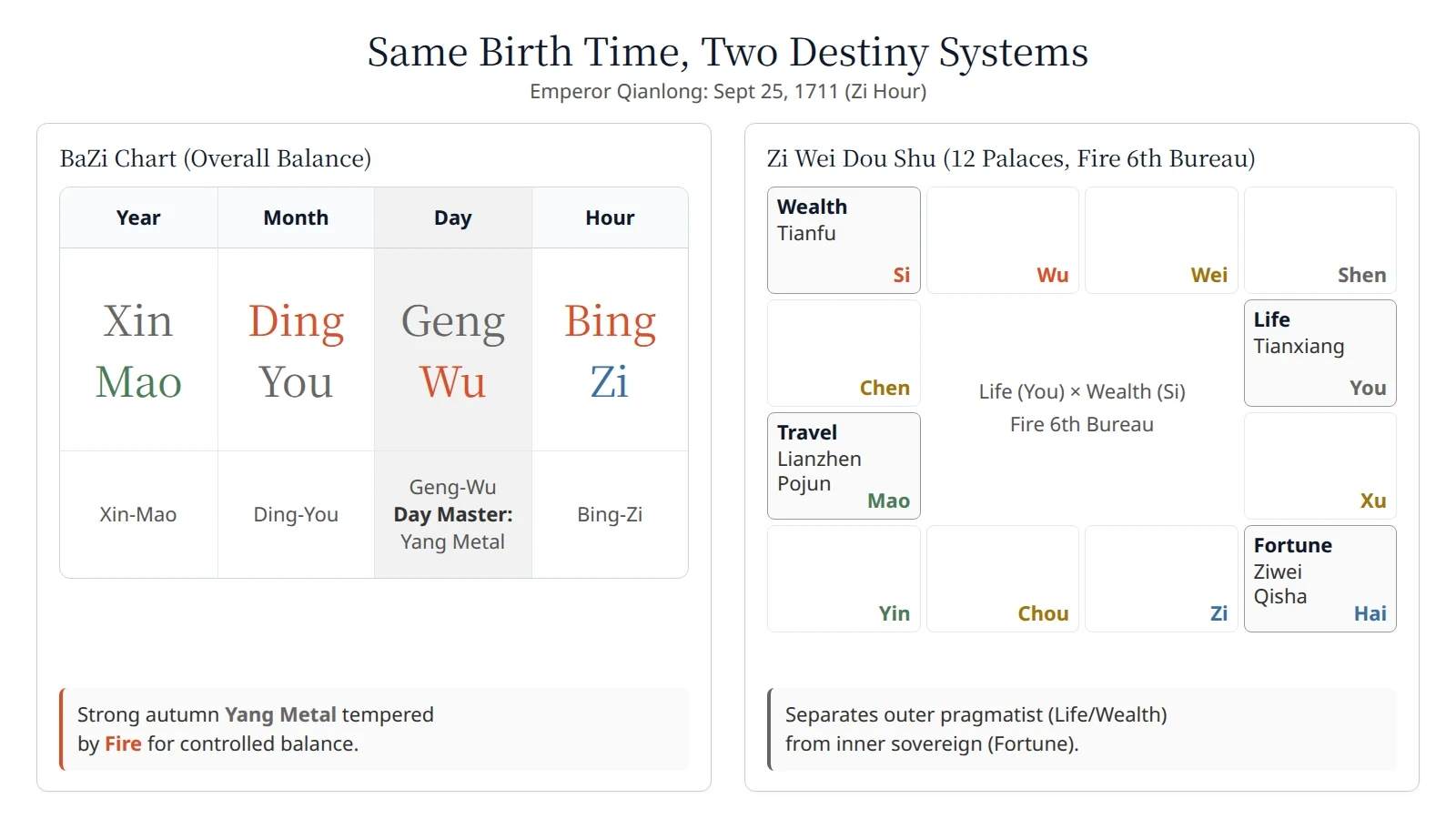
Comparison of the four pillars in BaZi (the Four Pillars of Destiny) and the major star placements across the twelve palaces in Zi Wei Dou Shu (Purple Star Astrology), derived from Emperor Qianlong's identical birth date and hour
Contrast Case: Zhu Yuanzhang's Complete Four Storehouses and an Empty Life Palace
Zhu Yuanzhang, the founding emperor of the Ming dynasty (born October 29, 1328, in the Wei hour (1–3 p.m.) on the 18th day of the 9th lunar month in the first year of the Yuan dynasty's Tianli era, as commonly cited from sources such as the Veritable Records of Ming Taizu), produces the opposite result. His BaZi chart reads Wu Chen year, Ren Xu month, Ding Chou day, Ding Wei hour. That is a rare configuration in which all four Earth storehouse branches (Chen, Xu, Chou, Wei) appear together. In Zi Wei Dou Shu (Water Two Bureau), his Life Palace (Mao) is an "empty palace" with no major star. It borrows Tian Ji and Ju Men from the opposite Travel Palace (You), and his Career Palace (Wei) holds Tai Yang and Tai Yin. Each chart, from a different angle, highlights the same thing: a path where his strength grew in response to circumstances rather than following a fixed type.
Accuracy When Your Birth Time Is Unknown, and Which System to Use
In practice, the biggest dividing line is whether you know your birth time. Take Shohei Ohtani: his birth date (July 5, 1994) is public, but his birth time has not been released. Even without the hour, BaZi can build three pillars (six characters): Jia Xu year, Geng Wu month, Ren Chen day. That is enough to read the framework of his Day Master (Ren Water) and the waves of his decade cycles. Missing the hour pillar does lower the precision of the Useful God. One caveat: under the convention that the day changes when the Zi hour begins at 11 p.m., someone born between 11 p.m. and midnight would take the next day's pillar, Gui Si. Zi Wei Dou Shu, by contrast, cannot fix the Life Palace without the hour branch, so the chart splits into as many as 12 candidates and cannot be settled without rectification—working backward from life events.
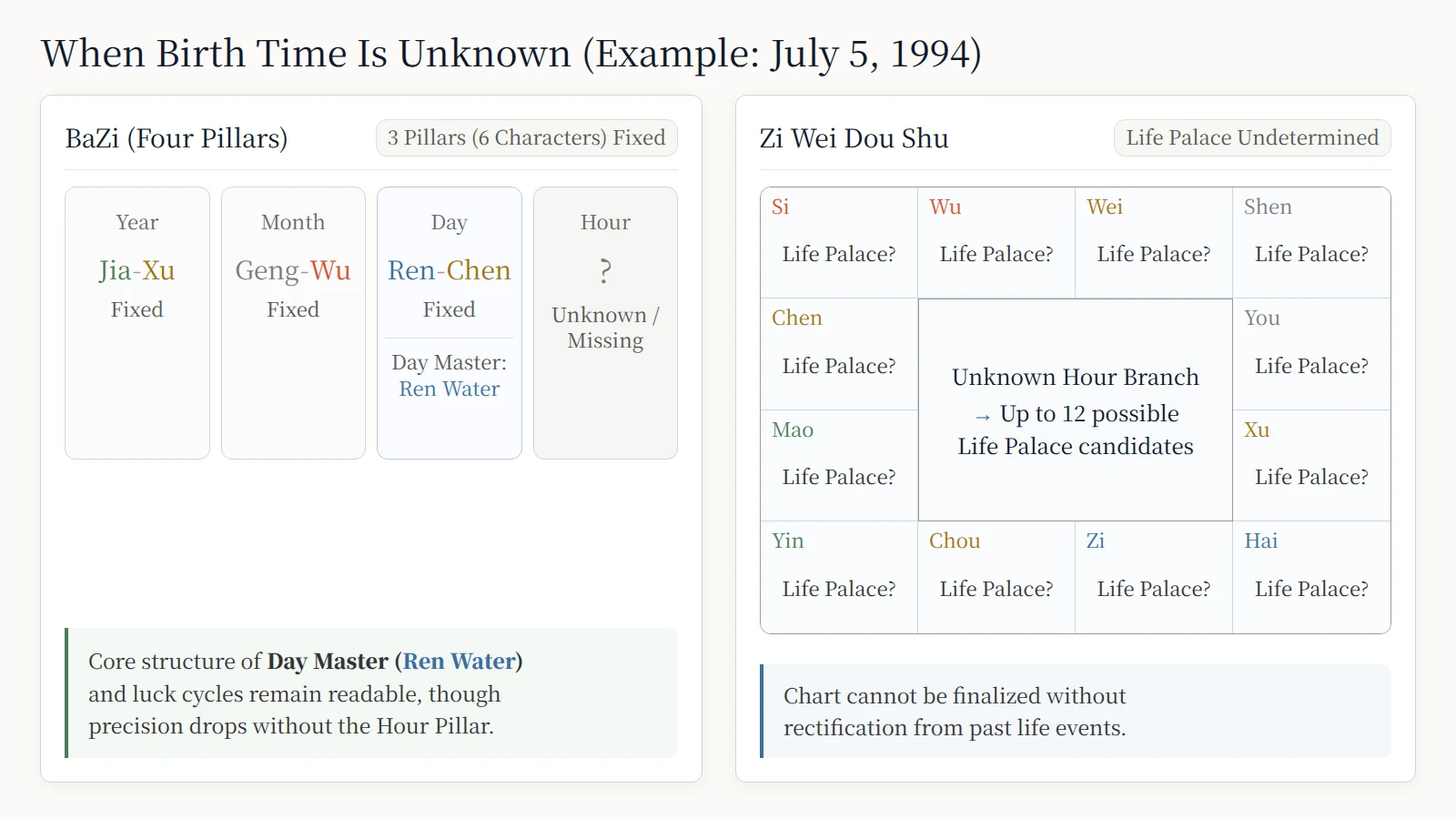
Accuracy gap when the birth hour is unknown: BaZi (the Four Pillars of Destiny) establishes the core chart from three pillars (6 characters), whereas Zi Wei Dou Shu (Purple Star Astrology) branches into up to twelve Life Palace candidates
Which One to Choose, and Which to Study: A Guide by Goal and Aptitude
When you're torn, the rule is clear. If your birth time is unknown, go with BaZi. If it's accurate, choose by the kind of question you're asking. Use BaZi for your temperament, the core of the work that suits you, and the long-term waves around changing jobs or going independent. Use Zi Wei Dou Shu to dig into romantic and marriage compatibility, emotional distance, workplace relationships, or what's moving this month.
Five Ways to Choose by Goal and Type
- You want to understand your temperament, your strengths, and the "why" behind them: BaZi, which lets you reason logically through the cause and effect of the stems, branches, and Five Elements.
- You want to study the interpretive tradition of Eastern classics in depth: BaZi, rich in classical debate from texts such as the Di Tian Sui (Dripping Heavenly Marrow) and the Qiong Tong Bao Jian (Precious Mirror of Thorough Insight).
- You want a concrete picture of love, marriage, and relationships, including what people really feel: Zi Wei Dou Shu, where the Spouse Palace, Friends Palace, and Fortune Palace show how a relationship works.
- You want to look at several areas at once, such as work, money, and family: Zi Wei Dou Shu, whose 12 palaces give you an overview of the whole balance.
- You want to pin down short-term moves, like "when to act" on a job change or a contract: Zi Wei Dou Shu, whose Four Transformations make month-by-month movement easier to track (pair it with BaZi for the long-term waves).
Tip:Rule of thumb: if your birth time is unknown, use BaZi. If it's accurate, split the work. Read your core and the big waves with BaZi, and read love, workplace interactions, and short-term movement with Zi Wei Dou Shu. That way you won't go wrong.
Why Use Both: How Serious Practitioners Combine Them, and Similar Systems
The two systems don't compete. Using them together is what reduces blind spots. BaZi shows the "overall climate" (a tailwind, or a time to hold steady), and Zi Wei Dou Shu shows "which of the 12 rooms the change happens in." Among systems similar to BaZi are Western astrology, which divides life areas into 12 houses, and Sanmeigaku, a Japanese system built on the same stem-and-branch calendar. In practice, some people layer palm reading or Nine Star Ki on top of destiny systems, combining the traditional trio of destiny, divination, and physiognomy (see Kaiun Tesou, for example), and cross-checking from several angles works well.
Two Workflows Practitioners Use to Combine Both Systems
- Career aptitude: Use BaZi's Useful God and Ten Gods to grasp "the core of the talents you can most readily express" (for example, a Fire Useful God points to expression and teaching), then use Zi Wei Dou Shu's Career Palace to fill in "your concrete role within an organization" (for example, the Zi Wei star plus the Tian Fu star points to management and oversight).
- Luck timing: At turning points such as a job change or a marriage, read "the keynote of that year" from BaZi's Luck Pillars and annual luck, then layer on Zi Wei Dou Shu's Four Transformations to check "which month and which palace (such as the Spouse Palace or the Wealth Palace) shows movement."
Start by Comparing Your Own BaZi Chart and Zi Wei Chart
Start by gathering your birth date and birth time, then check your Five Elements balance and Luck Pillars with our BaZi chart tool. If you also want to look at your relationships and your compatibility with a partner, try Compatibility Analysis as well, and use both as a map for checking your strengths and blind spots.
Frequently Asked Questions
Here are answers to common questions about how BaZi and Zi Wei Dou Shu differ, how to learn them, and how they compare with similar systems.
Do I Need Both BaZi and Zi Wei Dou Shu?
Not necessarily. In the early stages, studying one system in depth lets you learn it without getting confused. That said, BaZi reads long-term luck and Zi Wei Dou Shu reads the concrete picture area by area, so the two complement each other. Once your foundation is solid, combining them greatly widens the range of your readings.
Which One Is Harder to Learn?
BaZi is harder in theoretical depth, while Zi Wei Dou Shu is harder in the sheer number of elements to memorize. BaZi uses few symbols, but determining the Useful God takes time because it varies across classical texts and schools, while Zi Wei Dou Shu demands effort at the stage of memorizing combinations of the 14 major stars, the minor stars, and the Four Transformations.
Where Should a Beginner in Eastern Astrology Start?
We recommend starting with BaZi. Its framework of a timeline and the Five Elements makes the overall structure easy to grasp, and you can still practice with three pillars when someone's birth time is unknown. If you're interested in predicting short-term events and have an exact birth time, starting with Zi Wei Dou Shu works fine too.
Which One Goes Deeper in Chart Reading?
Neither is better. They go deep in different directions. BaZi has the more specialized toolkit for exploring a person's temperament, talents, and long-term cycles. Zi Wei Dou Shu has the more specialized toolkit for reading the concrete changes that unfold in each area of life, such as love, work, and family.
Do BaZi's Useful God and Zi Wei Dou Shu's Four Transformation Stars Correspond?
There is no one-to-one correspondence between them. The Useful God points to "the element needed to balance the Five Elements," while the Four Transformation stars point to "the direction in which change concentrates across the twelve palaces"; they are separate axes. Still, when you set the two side by side, a period of tailwind and the area where change happens often overlap.
Is the Life Palace in BaZi the Same as the Life Palace in Zi Wei Dou Shu?
The name is the same, but it carries different weight in a reading. In Zi Wei Dou Shu, the Life Palace is the central axis and the starting point for all twelve palaces, while in BaZi the Life Palace is only a supplementary reference read alongside the Four Pillars (the eight characters).
Are There Systems Similar to BaZi Besides Zi Wei Dou Shu?
Sanmeigaku, which uses the same stem-and-branch calendar, is close to BaZi, and Western astrology resembles Zi Wei Dou Shu in its structure of placing stars across twelve areas to read different fields of life. The difference is that Western astrology uses the actual positions of celestial bodies, whereas Zi Wei Dou Shu uses virtual stars derived by calculation.